Supercharging Google's Manufacturing Data Engine - How TwinGraph SDK can Elevate Digital Twin Creation for MDE Customers
Learn how TwinGraph SDK adds an intelligence and simulation layer atop Google's Manufacturing Data Engine to create dynamic, in-memory digital twins
By The TwinGraph team
Download PDFGoogle's Manufacturing Data Engine1 (MDE) is a formidable platform, offering manufacturers a centralized, scalable, and robust solution for ingesting, processing, and storing vast amounts of operational data from the factory floor. It lays the essential groundwork for Industry 4.0, providing the "what" and the "where" of manufacturing data. To transform this rich data into intelligent, actionable digital twins capable of complex reasoning and autonomous action, MDE customers can leverage TwinGraph SDK2.
TwinGraph SDK can act as an intelligence and simulation layer that sits atop MDE's powerful data infrastructure. While MDE excels at collecting and contextualizing data, TwinGraph SDK provides the tools to programmatically and quickly build dynamic, in-memory, graph-based digital twins that understand the relationships within that data, simulate real-world scenarios, and drive intelligent decision-making.
Bridging the Gap - MDE's Data Foundation Meets TwinGraph's Intelligence Layer
Consider MDE as the robust nervous system and circulatory system of your manufacturing enterprise — efficiently collecting, distributing, and storing all vital information. TwinGraph SDK then becomes the cerebral cortex, providing the advanced processing power and relational understanding to turn sensory input data into perception, reasoning, and intelligent digital twins.
Below shows how TwinGraph SDK seamlessly integrates with and elevates the capabilities for Google MDE customers:
Transforming Contextualized Data into a Living, Relational Model
- MDE's Role - MDE, through Manufacturing Connect, ingests raw machine data, unifies its format, and enriches it with contextual information. This data is then stored in BigQuery, Bigtable, or Cloud Storage, providing a clean, accessible foundation.
- TwinGraph SDK's Enhancement - TwinGraph SDK takes this contextualized data from
MDE and allows users to dynamically build in-memory, graph-based digital twins. Unlike
tabular data, a graph model inherently represents the relationships between machines,
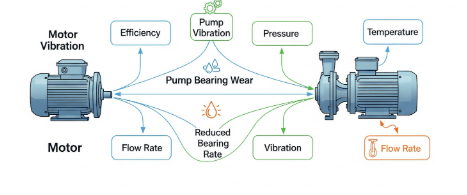
components, processes, and even human operators. A Pump node can be connected to
a Motor node, which is connected to a ProductionLine node, all operating within a
Factory node. This relational understanding is crucial for complex simulations and
reasoning that go beyond simple data analysis.
- Example - MDE might store vibration data for a specific motor and temperature data for a connected pump. TwinGraph SDK builds a graph where the Motor and Pump are connected, and their performance metrics (from MDE) are attributes of these nodes. This immediate relational context is vital for analyzing cause-and-effect or cascading failures.
Unleashing Python-centric Development for Deep Customization
- MDE's Role - MDE offers a scalable and flexible data platform, but building highly customized, simulation-rich digital twin applications on top of it often requires significant development effort.
- TwinGraph SDK's Enhancement - TwinGraph SDK provides a Python-centric
environment, allowing data scientists and developers to leverage the vast Python
ecosystem directly. This means MDE customers can use their existing skill sets and
integrate with popular data science libraries (Pandas, NumPy, SciPy, TensorFlow,
PyTorch) to:
- Develop custom simulation logic - Model complex physical processes, fluid dynamics, stress points, or chemical reactions within their twin.
- Build sophisticated analytics - Create bespoke algorithms for anomaly detection, root cause analysis, and predictive modeling that are specific to their unique manufacturing challenges.
- Integrate external models - Seamlessly pull in pre-existing physics-based models or machine learning models to enhance the twin's predictive capabilities.
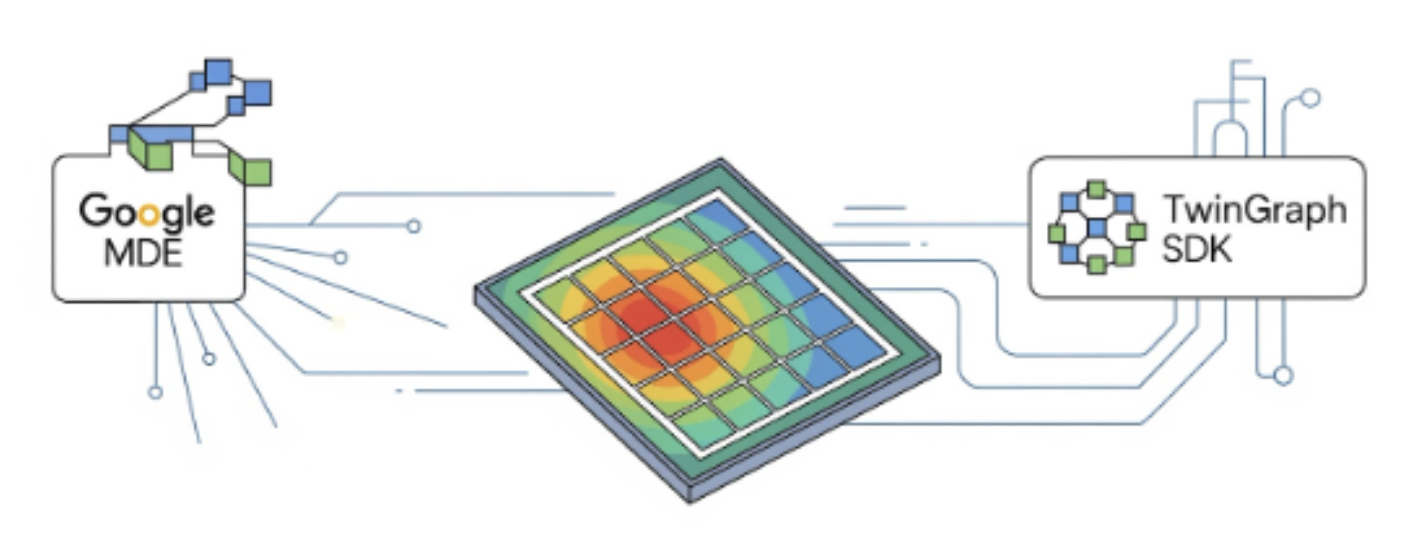
- Example - An MDE customer specializing in semiconductor manufacturing needs to model the thermal expansion of silicon wafers under varying conditions. TwinGraph SDK allows their engineers to build highly specialized thermal simulation models within the twin, feeding off the temperature and pressure data provided by MDE, to predict wafer yield with greater accuracy.
Accelerating Digital Twin Creation and Time to Value
- MDE's Role - While MDE streamlines data management, the creation of digital twin models from scratch can still be a time-consuming engineering effort.
- TwinGraph SDK's Enhancement - TwinGraph SDK provides the tools &
methodologies allowing users to model and leverage digital twins of manufacturing
assets and processes without having to build data models and/or frameworks from
scratch. Furthermore, TwinGraph's out-of-the-box MCP3 server can be paired with any
LLM, along with any other MCP server (e.g., Google's MCP Toolbox) enabling both
users and AI agents to rapidly prototype, modify, and orchestrate digital twins via the
power of an LLM. This can drastically reduce time to value from months to minutes.
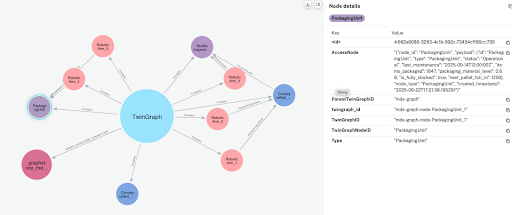
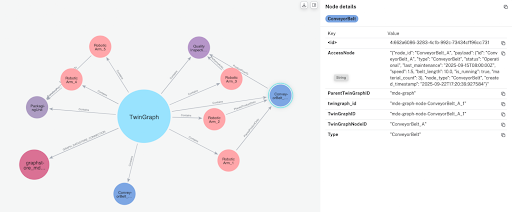
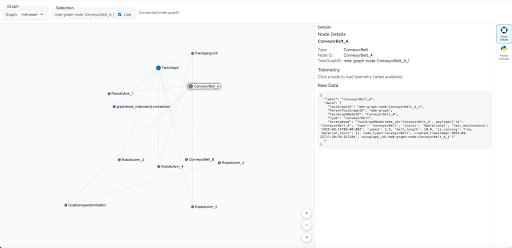
- Example - An MDE customer wants to create a digital twin of a new assembly line. Instead of manually coding every machine and connection, they can leverage a Google Gemini4 model with TwinGraph's MCP server — "Create a production line digital twin with five robotic arms, two conveyor belts, a quality inspection station, and a packaging unit. Connect Robotic Arm 1 and 2 to Conveyor Belt A, Robotic Arm 3 to Quality Inspection, and Robotic Arm 4 and 5 to Packaging." TwinGraph SDK leverages MDE's accessible data schema to suggest and build the foundational graph, which can then be further refined.
Enabling Proactive Intelligence with AI Agent Twin Components
- MDE's Role - MDE provides the data for insights, enabling human-driven decisions or triggering pre-programmed automation rules.
- TwinGraph SDK's Enhancement - With out-of-the-box compatibility with Google's
Agent Development Kit5 (ADK), AI agents can become active components of digital twins
themselves. This allows AI Agents to leverage data from MDE along with the context
provided via the digital twin's graph-based architecture to predict outcomes, and make
autonomous and/or proactive actions.
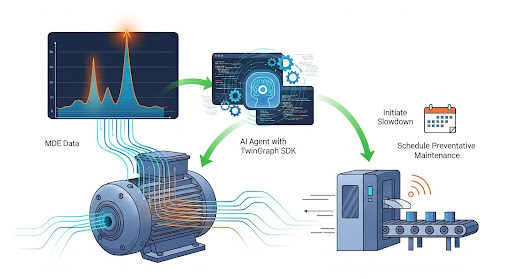
- Example - An MDE customer uses the data to identify a potential motor overheating issue. With TwinGraph SDK, an AI agent within the motor's digital twin can analyze the severity (using MDE data), simulate potential solutions, and then autonomously initiate a slowdown of the connected machine (if within pre-defined safety bounds) and schedule preventative maintenance, rather than waiting for a human operator to interpret an alert from MDE and act.
Comprehensive Observability for Trust and Validation
- MDE's Role - MDE ensures secure and reliable data ingestion and storage, laying the foundation for data integrity.
- TwinGraph SDK's Enhancement - Given its graph-based data foundation, TwinGraph
SDK complements MDE with its inherent observability of digital twins, and the
components digital twins are composed of. This ensures the integrity and trustworthiness
of the twin's models and simulations, enabling panoramic monitoring and meticulous
tracking of how data from MDE is used, transformed, and impacts the twin's behavior.
This is crucial for validating the reliability of digital twin-driven decisions.
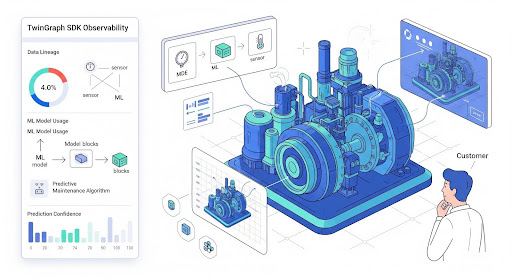
- Example - An MDE customer is relying on their digital twin for predictive maintenance. TwinGraph SDK's inherent observability allows them to track the lineage of data points from MDE (e.g., sensor readings), how they were used in the twin's ML models, and the confidence levels of the predictions, providing an audit trail and ensuring trust in the twin's recommendations.
Conclusion - A Synergistic Future for Manufacturing
Google's Manufacturing Data Engine provides the robust, scalable backbone for industrial data. By adopting TwinGraph SDK and MDE, customers can move beyond mere data management to create truly intelligent, dynamic, and actionable digital twins. This powerful synergy unlocks the full potential of Industry 4.0, allowing manufacturers to rapidly develop sophisticated solutions, foster proactive decision-making through agentic AI, and ultimately achieve unprecedented levels of operational excellence, agility, and competitive advantage. The combination of MDE and TwinGraph SDK offers a complete solution for building the factories of the future, today.
Sources
-
Google Manufacturing Data Engine - cloud.google.com/manufacturing-data-engine/docs/overview
-
Lucid TC TwinGraph SDK - lucidtc.com/twingraph
-
Model Context Protocol - modelcontextprotocol.io/docs/getting-started/intro
-
Google Gemini - gemini.google/overview
-
Google Agent Development Kit - google.github.io/adk-docs