Harmonizing Manufacturing Supply Chains with TwinGraph SDK & Google Cloud
Overcome the limitations of traditional digital twin platforms and fragmented supply chains in consumer product manufacturing
By The TwinGraph team
Download PDFIn the volatile landscape of modern manufacturing, the ability to transition from reactive management to autonomous, predictive operations is the ultimate competitive advantage. Manufacturers of large consumer products, ranging from home appliances to automotive systems, face the critical challenge of navigating highly non-linear supply chains where fragmented data silos and I/O latency in traditional tools prevent real-time visibility into the "ripple effects" of disruptions. Their primary objectives include achieving short-term operational resilience, such as mitigating shipping delays and inventory fluctuations, while pursuing long-term strategic goals like sustainability and autonomous, self-healing operations. Digital twins address these challenges by creating an executable intelligence layer, a "digital nervous system", that unifies heterogeneous data from IT and OT systems into a single, causal model. This allows manufacturers to move beyond passive monitoring to active reasoning.
However, traditional digital twin tools often miss large consumer product manufacturers' needs by acting as passive digital shadows rather than active execution layers. While marketed as real-time solutions, most legacy platforms are built on disk-based architectures that introduce significant I/O latency, making them incapable of the sub-second reasoning required to navigate non-linear supply chain disruptions.
Problem 1 - Slow Causal Mapping
In the short term, current tools struggle with causal complexity. Traditional digital twin platforms excel at monitoring individual assets but fail to map the "ripple effect" across a global network. When a logistics bottleneck occurs, legacy systems often require manual data reconciliation across siloed ERP and IoT databases. This fragmented data landscape prevents the immediate, automated "what-if" simulations needed to reroute shipments or adjust production schedules before a minor delay cascades into a total stockout.
Problem 2 - Vendor Lock-in and AI Stagnation
Long-term strategic objectives are hindered by closed ecosystems and lack of agentic intelligence.
- IP Portability - Many digital twin platforms use proprietary languages and/or infrastructure that lock a manufacturer's operational logic into a specific vendor's cloud, stifling innovation and IP portability.
- AI Safety - Existing tools lack a "safety-first" framework for AI. They can suggest actions but cannot safely simulate and validate autonomous decisions against complex engineering constraints. Ultimately, current digital twins are often just sophisticated visualizations, 3D mirrors that show a problem as it happens but lack the "nervous system" to independently sense, simulate, and solve it.
TWINGRAPH SDK + GOOGLE: In-Memory Executable Intelligence
By integrating TwinGraph SDK with Google Cloud's Data and AI ecosystem, organizations can build a "living" digital nervous system. This combination allows for the transformation of fragmented data into an executable intelligence layer that optimizes their supply chain. TwinGraph SDK provides the backbone for intelligent industrial operations. An in-memory graph framework that unifies real-time data, persistent storage, and AI logic into a responsive 'nervous system' for modern factories, distribution networks, and enterprise-grade digital twins (See Figure 1). By maintaining the entire operational model in memory, it bypasses the latency of traditional databases, enabling sub-second graph traversals and real-time causal reasoning across complex industrial assets. It functions as an open, developer-centric bridge that unifies disparate data streams—including real-time OT telemetry, IT transactional records, and engineering specifications into a single, executable model of reality that eliminates vendor lock-in and scales within existing scientific computing ecosystems.
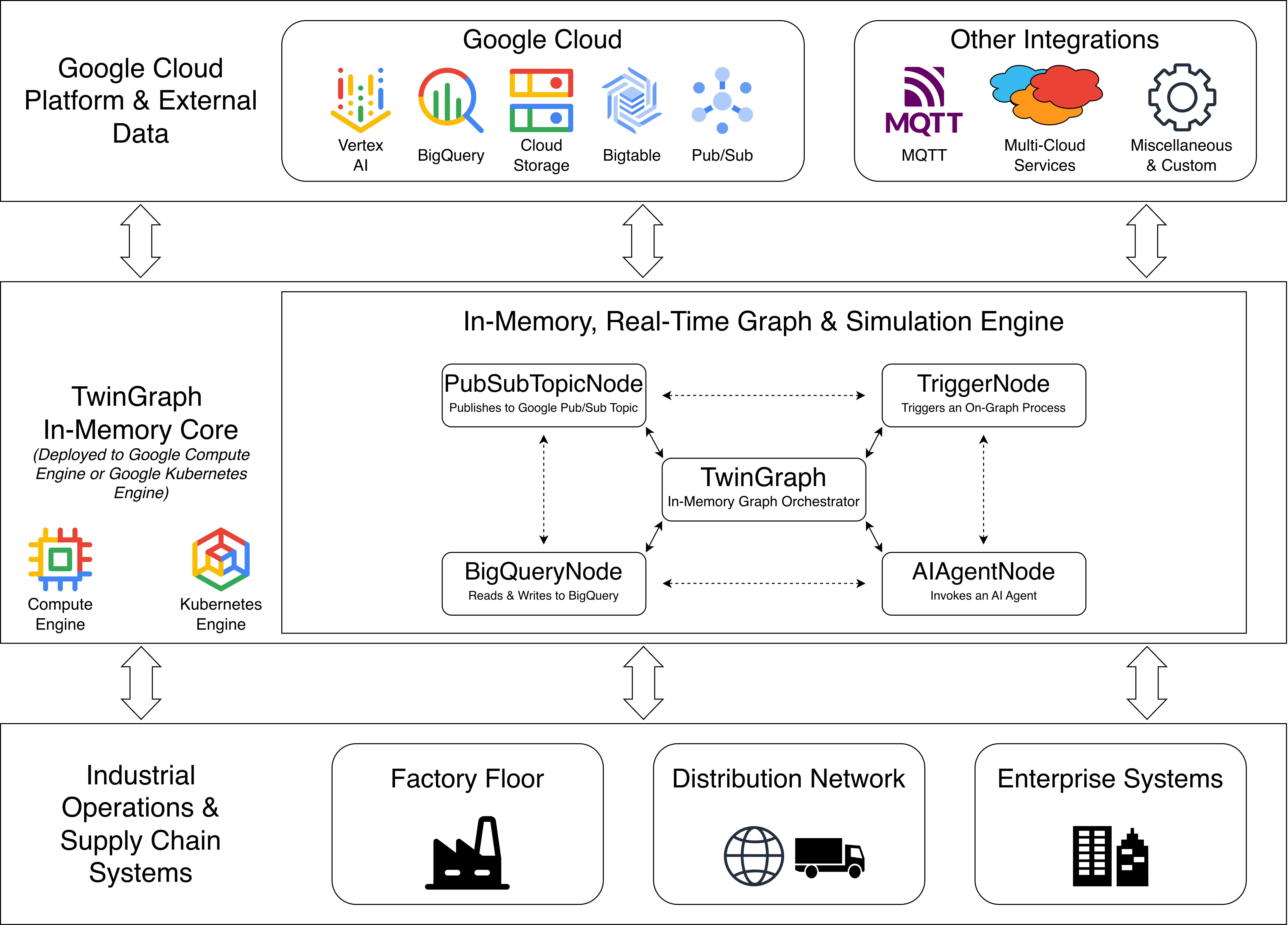
Beyond simple data modeling, the SDK acts as a sophisticated environment for Agentic AI and AI Safety, allowing autonomous agents to simulate and validate actions against physical constraints before execution. It leverages the Model Context Protocol (MCP) to accelerate development, using LLMs to automatically generate graph schemas and boilerplate code from natural language descriptions. Ultimately, TwinGraph SDK transforms static industrial data into a dynamic intelligence asset capable of autonomous problem detection, simulation, and resolution within complex, non-linear distribution networks and factories.
Immediate Value - Agility and Resilience
In the short term, manufacturers want to solve for "The Now." This involves mitigating disruptions, managing inventory fluctuations, and ensuring on-time delivery.
Sub-Second Disruption Mapping - Traditional supply chain tools often suffer from I/O latency, taking minutes or hours to calculate the "ripple effect" of a delayed shipment. Because TwinGraph SDK executes in-memory, it can perform sub-second graph traversals. If a Tier-2 supplier in Southeast Asia reports a delay, TwinGraph-built digital twins can instantly identify every downstream assembly line and customer order affected, allowing managers to reroute logistics before the bottleneck even forms.
Gen AI-Powered Operational Control - Using the TwinGraph MCP Server and Google Gemini, plant managers can interact with their supply chain using natural language. Instead of running complex SQL queries, a user can ask: "What is the impact on Q3 refrigerator production if the Suez Canal is blocked for 48 hours?" Gemini translates this intent and executes the simulation against the TwinGraph digital twin, providing an immediate, grounded risk assessment.
Future Value - Sustainable Operations
Over the long term, the goal shifts toward structural efficiency, sustainability, and AI safety.
AI Safety and Agentic AI
- The ultimate evolution of the supply chain is one that can heal itself. By deploying Agentic AI within and/or on top of TwinGraph, manufacturers can empower AI agents to take corrective actions—such as reordering safety stock or shifting production loads between factories.
- With AI Safety, the AI Agent can first simulate its proposed action within the TwinGraph environment to verify it doesn't violate physical constraints or engineering logic before the command is pushed back to the physical system via Google Cloud's integration layers.
Designing for Sustainability and Cost - By leveraging Google Cloud's Vertex AI alongside TwinGraph, manufacturers can run "What-If" scenarios for the next 5–10 years. They can optimize for the "Greenest Path" by analyzing the carbon footprint of every edge in the graph. This allows for long-term strategic decisions—like where to build the next distribution center—to be based on a holistic model of reality rather than static spreadsheets.
The Core Differentiator: Speed & Location of Truth
Below is a comparison table illustrating why TwinGraph's in-memory, executable approach is the necessary evolution for high-stakes consumer product supply chains. The core differentiator is the location of truth. Traditional tools treat the graph as a storage format; TwinGraph SDK treats the graph as a computing engine.
| Feature | Traditional Digital Twin Platforms | TwinGraph SDK (In-Memory) |
|---|---|---|
| Primary Data Locality | Hard Drive / SSD (High Latency) | Memory (Nanosecond Latency) |
| Reasoning Model | Passive: Mirroring what happened. | Active: Executing logic on the fly. |
| Traversal Speed | Milliseconds to Minutes (I/O Bound) | Sub-millisecond (CPU Bound) |
| Logic Portability | Non-Portable, Largely Proprietary | Native Python (Open Ecosystem). Vendor and Platform Agnostic |
| Autonomous Control | Human-in-the-loop required for safety. | Human-in-the-loop and AI Safety - AI simulates before acting. |
| Contextual Fusion | Hard-coded ETL pipelines. | Dynamic, Gen AI-accelerated schema. |
Proof Points: From Crisis to Calculated Adjustments
The following examples look at several high-profile supply chain crises from 2024 and 2025. These incidents highlight the systemic failures of "static" data silos and how a TwinGraph SDK world model could have shifted the outcome from crisis to calculated adjustment.
The Red Sea Logistics Crisis (2024–2025)1
The Incident: Ongoing geopolitical tensions forced major shipping lines to reroute around the Cape of Good Hope, adding ~10-14 days to transit times and increasing fuel costs by hundreds of thousands of dollars per voyage. For appliance manufacturers, this meant "just-in-time" components for assembly lines in Europe and North America simply vanished.
The Failure: Traditional ERP systems flagged the delay but could not instantly re-calculate the "cascading impact" on specific production shifts. Manufacturers suffered from "line stops" because they could not identify which alternative SKUs could be built with existing on-hand inventory.
TwinGraph Solution
-
Autonomous Rerouting - TwinGraph's low-latency execution layer could have run thousands of "what-if" simulations the moment a vessel was diverted, automatically triggering "Express Air Freight" orders for high-value microchips while slowing down production of low-priority units to preserve floor space.
-
Causal Linkage - It would have mapped the delay not just as a "date change," but as a causal break in the assembly of specific smart-fridge models, suggesting an immediate pivot to a model with a localized supply chain.
The $818 Billion "Inventory Distortion" Gap (2024)2
The Incident: Major retailers and manufacturers reported massive losses due to "inventory distortion"—a combination of overstocking unwanted items and stockouts of high-demand products. A major athletic apparel company, specifically, forecasted a mid-teens sales decline in early 2025 due to a failure to pivot away from post-pandemic overstock.
The Failure: Most teams rely on historical sales data (statistical correlation) rather than real-time causal factors like shifting consumer sentiment or regional weather patterns.
TwinGraph Solution
-
Contextual Fusion - By integrating Google Trends and Vertex AI demand forecasting directly into the graph, TwinGraph would have detected the "cooling" demand for specific sportswear lines weeks earlier.
-
Dynamic Rebalancing - Instead of dumping $30M of inventory into landfills (as seen with Funko Pop in 2023/24), the system could have autonomously rerouted excess stock to secondary markets or adjusted factory outputs before the surplus even reached the warehouse.
Record-Breaking Product Recalls (2025)3
The Incident: By late 2025, the CPSC (Consumer Product Safety Commission) exceeded the previous record for product recalls, with over 370 major safety warnings. Many involved battery overheating or structural failures in household appliances and power tools.
The Failure: When a defect is found, manufacturers often struggle to identify the exact scope of the problem. They recall 1,000,000 units because they cannot prove which 10,000 units actually used the defective batch of sensors or sub-components.
TwinGraph Solution
-
Digital "Birth Certificates" - TwinGraph creates a node for every individual asset. If a batch of batteries is flagged as faulty, the graph identifies every serial number those batteries were installed in, across which distribution centers they are currently located, and which customers bought them.
-
Surgical Recalls - This allows for a "Surgical Recall" rather than a "Blanket Recall," saving millions in logistics and preserving brand trust.
EU Battery and "Right to Repair" Regulations (2025)4
The Incident: New EU regulations (2024/1781) and China's updated RoHS standards (2025) introduced strict documentation requirements for the "circularity" and repairability of household appliances.
The Failure: Companies are struggling to compile the "Digital Product Passport" required by law because their engineering data, chemical compliance data, and manufacturing records are in three different systems.
TwinGraph Solution
- The "World Model" as a Single Source of Truth - TwinGraph naturally links Engineering Data to Operational Tech (IoT) and IT (e.g., BigQuery).
- Automated Compliance - The SDK can automatically generate the required compliance graph for every SKU, proving that every component—down to the solder—meets the new environmental standards, preventing costly "Greenwashing" fines or market bans.
TwinGraph Strategic Roadmap - A Business Value Checklist
By utilizing TwinGraph SDK, organizations can seamlessly map complex physical ecosystems to a digital environment with sub-second synchronization. This roadmap outlines the strategic evolution from foundational data visibility to a fully autonomous, self-optimizing supply chain.
Phase 1 - Unified Network Visibility
Strategic Objective - Break down information silos to create a single, digital representation of the entire supply chain.
Action: Aggregate data from legacy systems, regional databases, and spreadsheets into a TwinGraph digital twin.
- Business Outcome - Eliminates "blind spots" in the network, reducing the time spent manually reconciling data between departments.
- Stakeholder Benefit - A single source of truth that allows leadership to see the health of the entire global operation in one view.
Phase 2 - Live Operational Intelligence
Strategic Objective - Move from "what happened yesterday" to "what is happening right now."
Action: Connect live feeds from warehouses, transport fleets, and factory floors directly into the TwinGraph digital twin.
- Business Outcome - Real-time tracking of high-value assets and inventory levels, allowing for immediate response to delays or quality issues.
- Stakeholder Benefit - Reduced working capital requirements through better inventory accuracy and lower safety stock levels.
Phase 3 - Conversational & Predictive Insights
Strategic Objective - Empower non-technical managers to interact with supply chain data using artificial intelligence.
Action: Embed specialized AI Agents into specific nodes of the supply chain digital twin, such as procurement or logistics, to monitor performance and forecast demand.
- Business Outcome - Decision-makers can "chat" with their supply chain to get instant reports, risk assessments, or optimization suggestions.
- Stakeholder Benefit - Faster, data-driven decision-making at the "speed of thought," bypassing the need for complex custom report requests.
Phase 4 - Autonomous Exception Management
Strategic Objective - Automate the resolution of routine disruptions to free up human talent for high-value tasks.
Action: Configure the TwinGraph digital twin to automatically identify anomalies (e.g., a shipment stuck at a port) and trigger pre-approved resolution workflows.
- Business Outcome - Significant reduction in "firefighting" time for operations teams and minimized cost impact from standard logistics delays.
- Stakeholder Benefit - Improved service level agreements (SLAs) and customer satisfaction through more reliable delivery timelines.
Phase 5 - Strategic Agility & Self-Optimization
Strategic Objective - Future-proof the organization by creating a supply chain that learns and evolves.
Action: Use the TwinGraph digital twin to run "What-If" simulations, testing new suppliers or shipping routes in a risk-free virtual environment before real-world execution.
- Business Outcome - Continuous improvement of the supply chain's efficiency, automatically adjusting configurations to optimize for cost, speed, or sustainability goals.
- Stakeholder Benefit - Long-term resilience and a definitive market advantage by being able to pivot the supply chain faster than the competition.
Outcome
Adopting this roadmap transforms the supply chain from a reactive cost center into a proactive, intelligent asset capable of automated self-correction and strategic foresight. TwinGraph provides the architectural foundation for unmatched organizational resilience and a definitive competitive advantage in an increasingly competitive global market.
Conclusion - A Future-Proof Framework
The integration of TwinGraph SDK and Google Cloud represents a definitive transition from static digital twins to a dynamic, executable intelligence layer. This powerful combination is more than a technical upgrade; it is the architectural foundation for a future-proof supply chain.
Google Cloud provides the necessary global scale, industry-leading security, and a rich ecosystem of world-class AI solutions (like Gemini and Vertex AI). TwinGraph SDK delivers the Python-native interface to a high-performance core that eliminates the latency and vendor lock-in inherent in legacy systems.
By operating with sub-second, causal reasoning and a robust AI Safety layer, the resulting digital nervous system allows manufacturers to move beyond merely reacting to disruptions to a state where their supply chain can sense, simulate, and self-correct with guaranteed safety.
For the manufacturer of large consumer products, this translates directly into a tangible competitive advantage: fewer stockouts, dramatically reduced operational waste, precision in product recalls, and the ability to optimize for long-term strategic goals like sustainability. The TwinGraph + Google Cloud framework ensures that the supply chain is no longer a reactive cost center but a proactive, intelligent asset that doesn't just survive volatility, but thrives on it.
Sources
-
Red Sea Shipping & Logistics Volatility (2024–2025) - J.P. Morgan Research – "The Impacts of the Red Sea Shipping Crisis." Documented a 9% reduction in global container capacity and a 30% increase in transit times, causing immediate production pauses for major European manufacturers.
-
Nike Inventory Distortion & Revenue Impact (2024) - Hypersonix AI / Wall Street Journal – "Excess Inventory Hurts Nike Profits." Nike reported a record 44% increase in inventory (reaching $9.7 billion) due to late-arriving seasonal goods, leading to massive liquidation headwinds and a 20% stock plunge in mid-2024.
-
Surge in Product Recall Severity (2025) - Sedgwick Brand Protection – "U.S. Product Safety and Recall Index (Q3 2025)." While recall events fell slightly, the total volume of units recalled surged over 200% in late 2025. Consumer product recalls hit a 14-year high, largely due to "blanket recalls" caused by a lack of serial-level component traceability.
-
EU Digital Product Passport (DPP) Mandate (2025–2027) - European Commission / Worldly – "The EU's Digital Product Passport Requirements." Implementation for batteries and consumer electronics began in 2025 under the ESPR framework, requiring manufacturers to provide a full "digital lifecycle record" for every unit sold in the EU market.